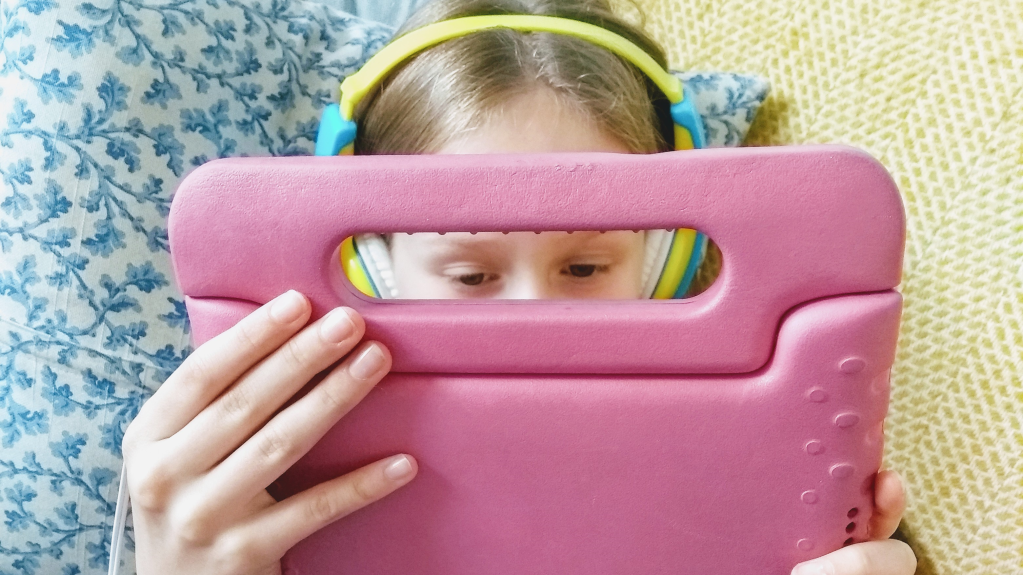
“You’ll melt your brain!” is a phrase I use daily to my children when they start to go over their pre-agreed iPad time. I have little evidence for this really being a risk but that hasn’t stopped me banging this particular drum throughout my parenting years so far. Thinking back on it, my mum used to say something similar to my brother and I when we played on our Amiga 500 console in the early 90s, or we’d be warned of getting ‘square eyes’ for watching too much TV.
Lock-down has of course dramatically accelerated everyone’s screen time, but is it necessarily good or bad? Is it the predictable outcome of participating in the information age or will my brain finally melt by Christmas time?
Moral panics about new technology are nothing new. In my own memory, there have been a steady stream of inventions hailed as the beginning of the end of humanity including; Multichannel TV (which would stop us needing to leave the house or socialise ever), Google (which would end our need to retain information) and scientific calculators – well I still don’t understand what they do, but anyway…
Perhaps we can learn something if we go back further to a time when ‘scrolling down’ was the preserve of the rich, involving animal skins, a scribe and the use of both hands. Around about 2,400 years ago, Plato (you know – student of Socrates, teacher of Aristotle – very much the meat in the Ancient Greek philosophy sandwich) spoke of his worry over a new kind of technology that would make us all stupid – yes, ‘writing’.
This sounds ridiculous to us now, after all we hold up libraries and the sales of Harry Potter paperbacks as signs of our civilisation having one of its good days. Nonetheless, his argument was not that there was anything stupid about writing things down in itself, but that it could lead to people relying on the technology. That by using the written word instead of fully engaging our brains, we would cease to think properly. He said;
“Writing, […] has this strange quality, and is very like painting; for the creatures of painting stand like living beings, but if one asks them a question, they preserve a solemn silence. And so it is with written words; you might think they spoke as if they had intelligence, but if you question them, wishing to know about their sayings, they always say only one and the same thing. And every word, when once it is written, is bandied about, alike among those who understand and those who have no interest in it, and it knows not to whom to speak or not to speak; when ill-treated or unjustly reviled it always needs its father to help it; for it has no power to protect or help itself.”
Plato would have been a tough man to pin down to a contract agreement then… He seems to be saying that writing is no replacement for thought. Or to take it further, that as long as you keep on using your brain once you have read something, we’ll all become better thinkers. And so to the question; What would Plato say about mine and my kids’ use of screens?
I think he would say it’s not about what you are using, but how you are using it. Every technology can be over-used, misused and abused and we love to worry about it when it is. I think we need to use this extraordinary time to start working more critically with the screen-based technologies which we are now all so immersed in, starting with the next generation.
So, rather than putting my kids’ iPads straight back in the cupboard the next time I worry they are running over time their time, I am going to try spending a few minutes talking to them about what they are looking at. You never know, they could be forming an idea for a new series of bestselling books about a wizard school or designing a large building to put copies of them in. It’s not exactly gold-standard home-schooling or critical thinking but I reckon it’s what Plato would do.
 MyOnwardAndUpward.com